
Provenance
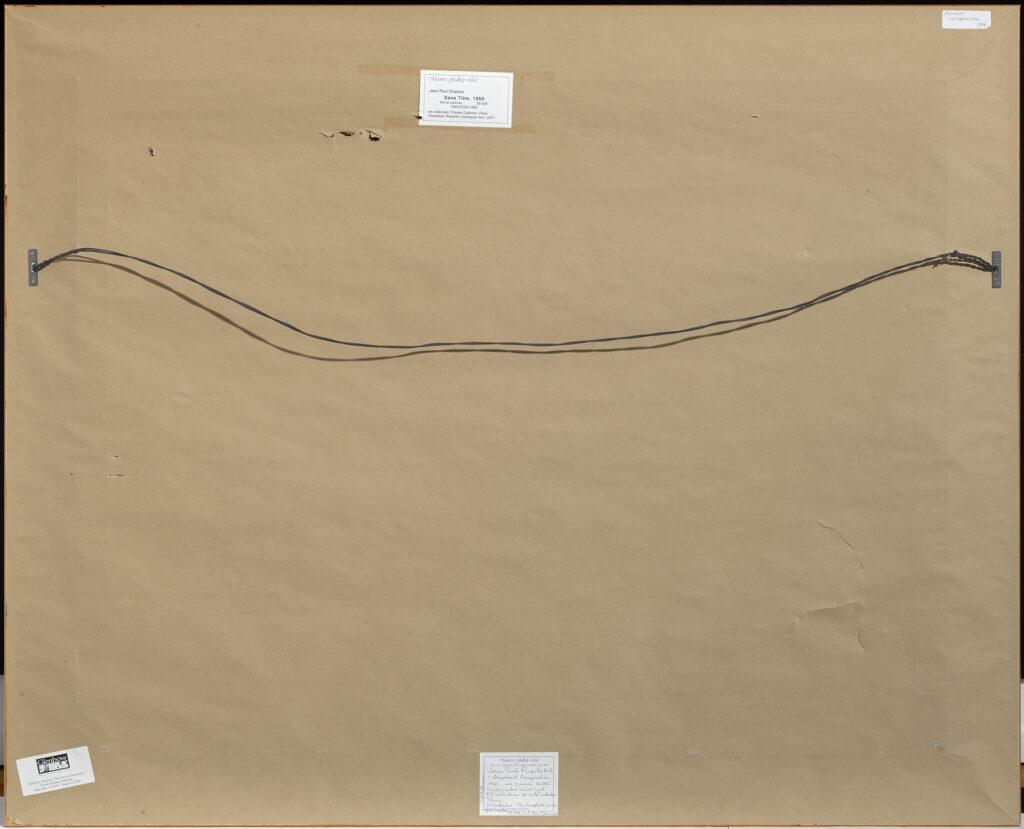
Acquired directly from the Artist, Paris, 1950
Private Collection, Paris
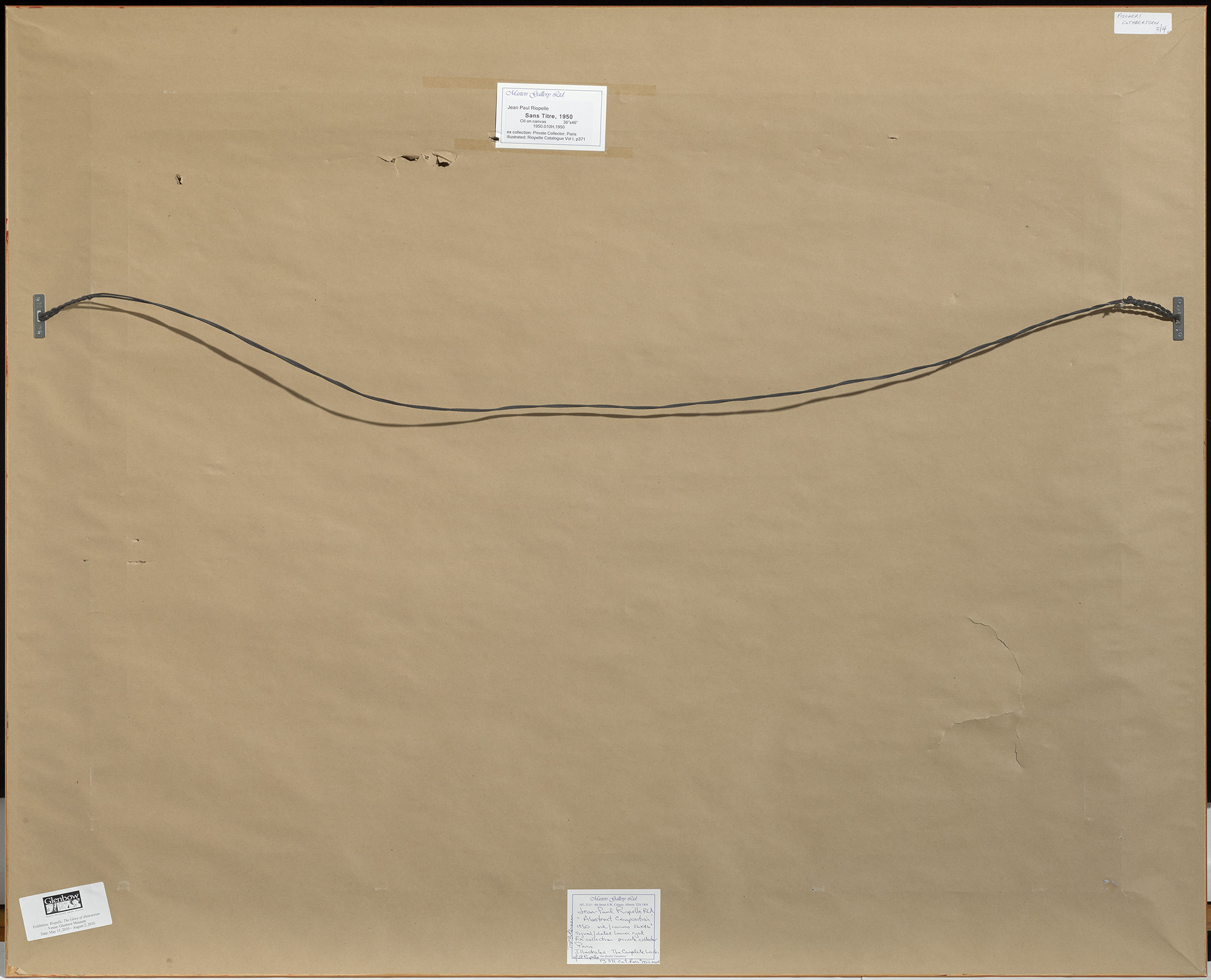
Masters Gallery, Calgary, 15 September 2007
Private Collection
Literature
Jean-Louis Prat, ‘Foreword’ in Pierre Théberge, Riopelle, Montreal, 1991, page 12
Yseult Riopelle, Jean Paul Riopelle: Catalogue Raisonné, Volume 1, 1939-1953, Montreal, 1999, reproduced page 371, no. 1950.010H.1950
“Jean Paul Riopelle stands at the crossroads of renewal that confronted both the realm and the individual act of painting in the fifties. Related to American and European art but nonetheless distinct, his work has its source in a culture of instinct, one that aims to rigorously preserve its autonomy and its vision while solidly reinforcing the soil from which it springs.” – Jean-Louis Prat
After an initial visit to France in 1946, where Jean Paul Riopelle found an atmosphere conducive to pursuing his artistic ambitions, he settled permanently in Paris in 1947. In 1948, he returned briefly to Montreal for the birth of his eldest daughter and to sign, along with his fellow Automatistes, the Refus Global manifesto—written by his mentor Paul- Émile Borduas, for which Riopelle also designed the cover. In Paris, Riopelle felt freed from the oppressive weight of the Grande noirceur (“Great Darkness”), the period during which the Catholic Church and Premier Maurice Duplessis imposed strict control over Quebec society from 1944 to 1959. The artist sought to invent his own visual language and to create freely, far from dogma and constraint.
It is interesting to observe Riopelle’s formal evolution in the works created between 1949 and 1955, the earliest of which were influenced by French Surrealism—a movement he began distancing himself from by 1949 and 1950. Beginning in 1949, with Le Perroquet vert (“catalogue raisonné”, no. 1949.010H.1949, pages 277, 369), Riopelle abandoned the paintbrush, instead using a dropper and palette knife to create fine, interlacing lines that crisscross the surface like overlapping nets across the canvas from edge to edge.
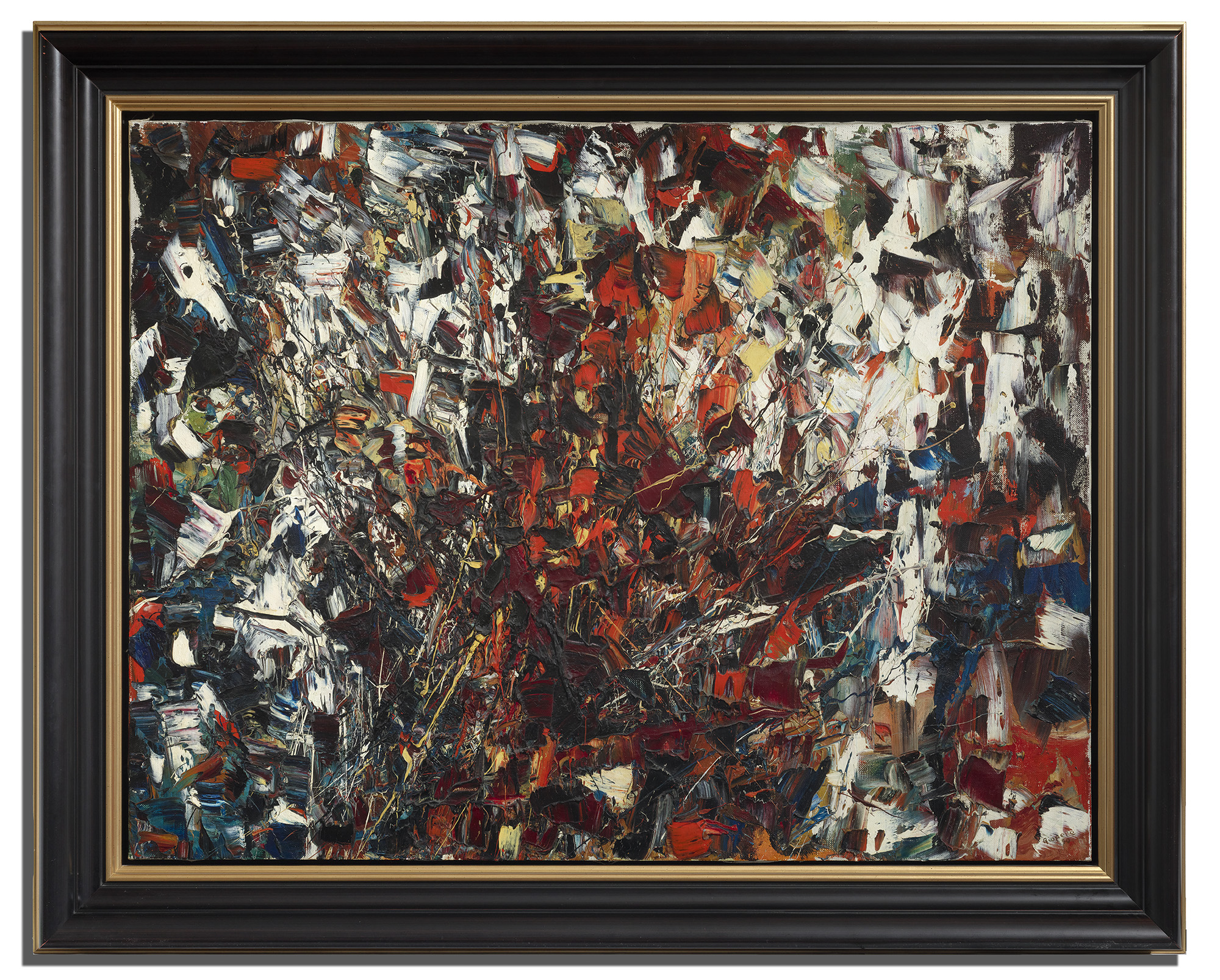
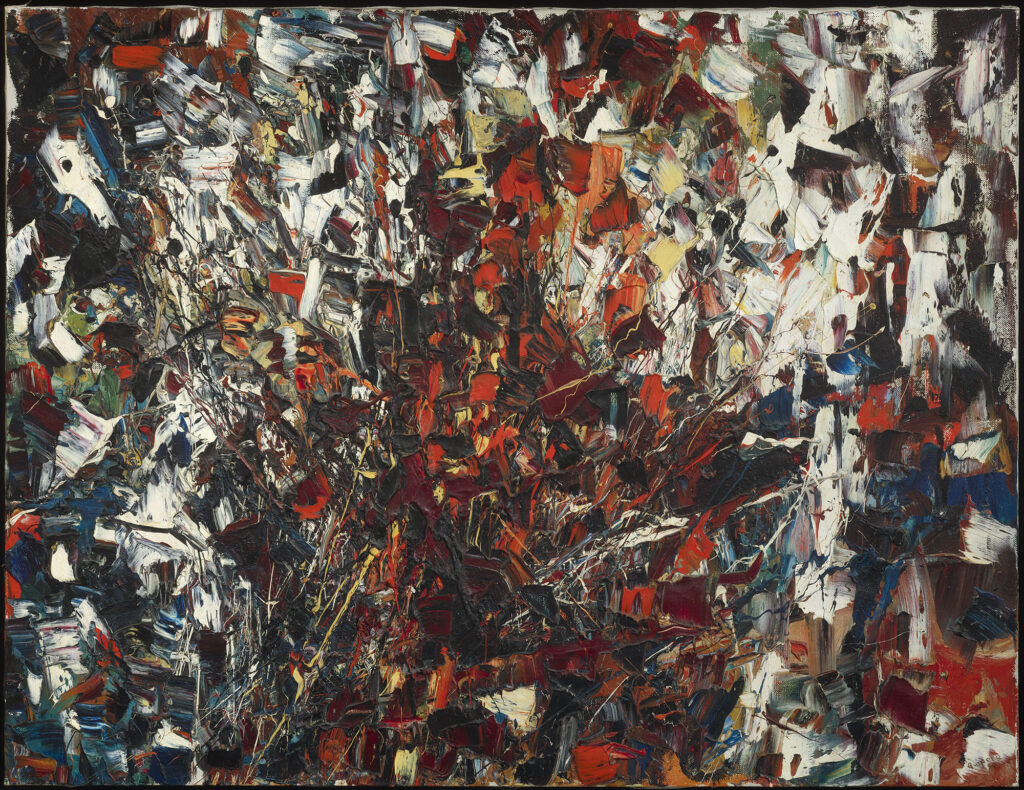
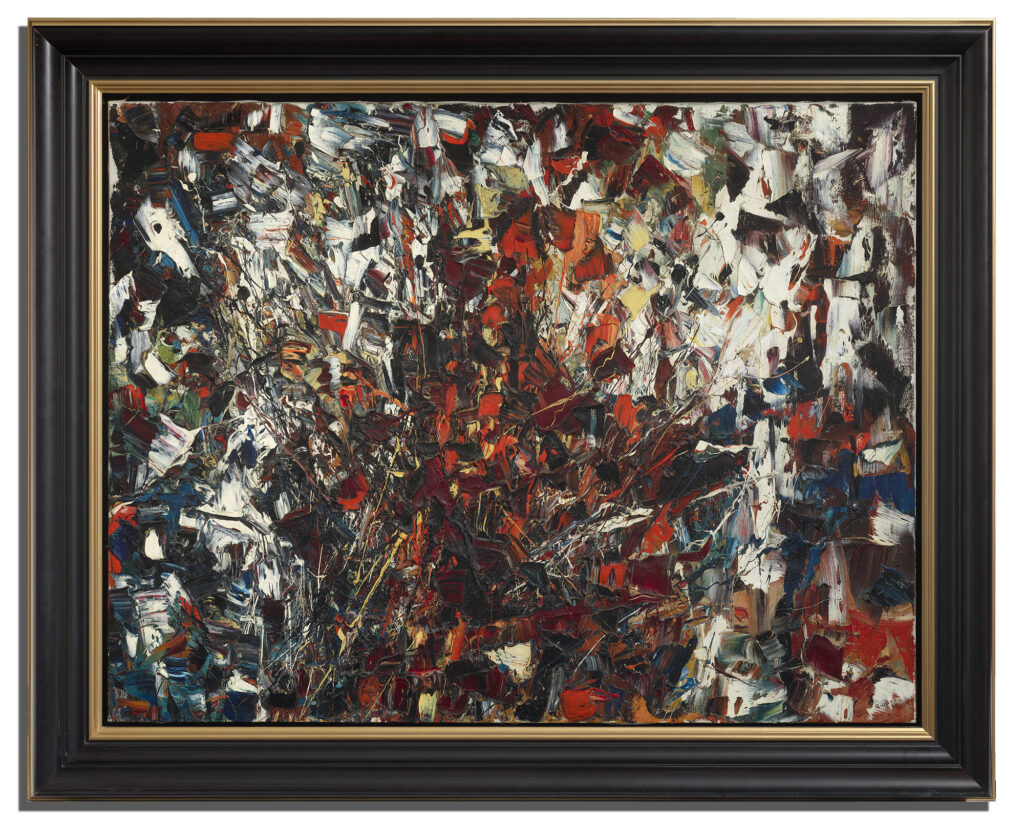
Riopelle began his Mosaic series in 1950, including Sans titre. While one can still discern the influence of Automatiste painting, Riopelle was at a pivotal moment in his career, marking the beginning of a new approach. The works from this period recall the style of his ink and watercolour compositions. In formal terms, the ‘all-over’ composition is animated by filaments and splashes of light, in vibrant and at times darker colours that sweep across and energize the surface.
It was at this time that Riopelle began applying paint in thick impastos. He often joked that he painted thickly because he did not know how to make “thin paintings.” In this regard, art critic Patrick Waldberg described Riopelle’s works as “oil sculptures.”
All of the paintings from this creative period are emblematic of a remarkable transition that set Riopelle apart from his contemporaries—through the vigour of his gesture and the force of his expression. Early in this new phase, he abandoned the Automatiste credo of hasard total, since, as has been observed, “Riopelle knew well that ‘total chance’ could turn out to be another illusion, much like the ‘naïveté’ so cherished by the Impressionists.” For him, what mattered above all was intensity—an intensity matched by his extraordinary mastery of the medium and his unfailing sense of composition. His canvases are structured by interlacing bands and sections of colour that give the work both an architectural framework and a heightened dynamism.
Sans titre was acquired directly from Riopelle in 1950, in lieu of rent for the artist’s studio in Paris. The painting was then treasured by the family, remaining in the collection until 2007 when Masters Gallery in Calgary was entrusted with the oil on canvas.
We extend our thanks to Sylvie Lacerte, PhD, art historian and independent researcher, for her assistance in researching this artwork and for contributing the preceding essay.