Provenance
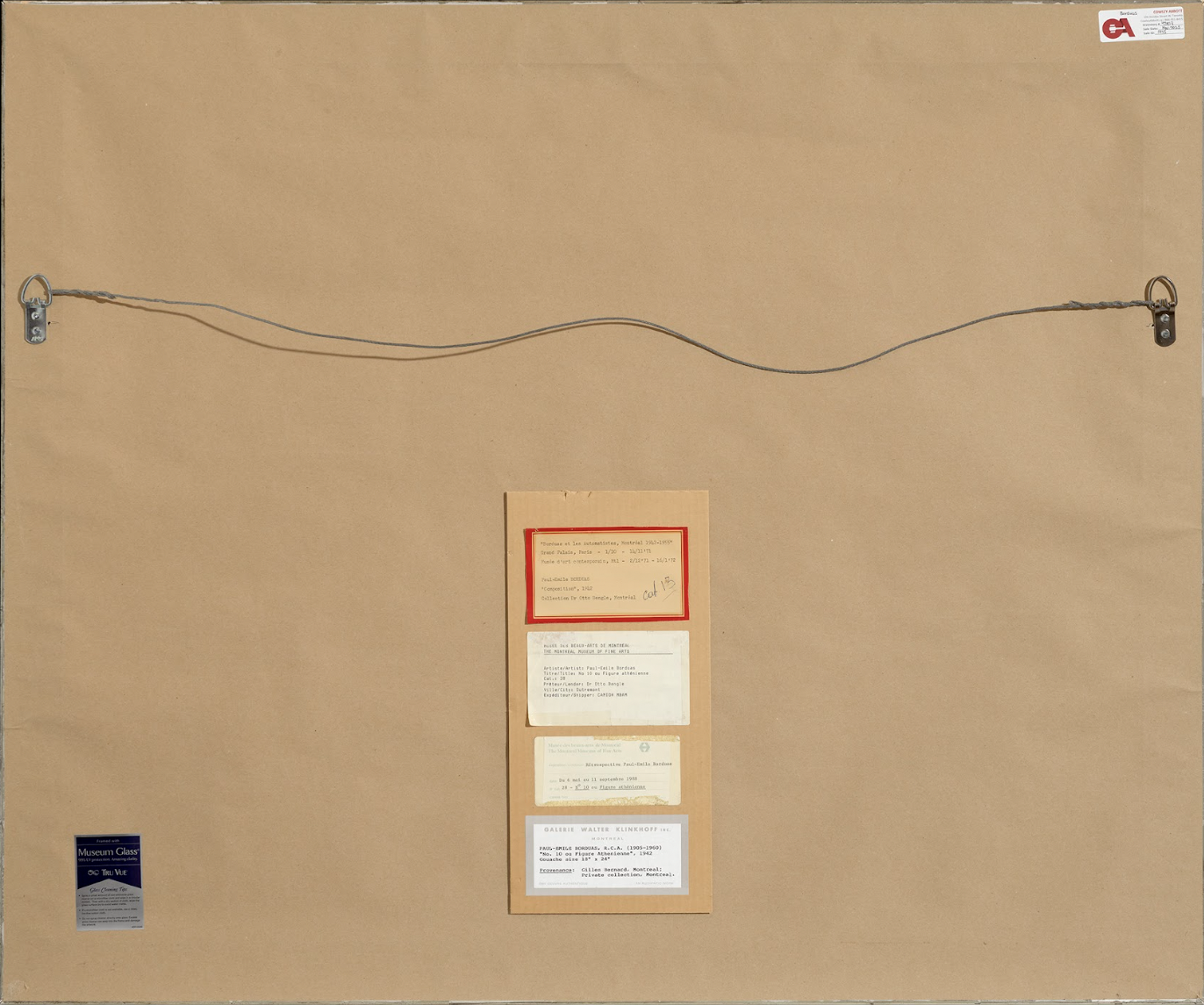
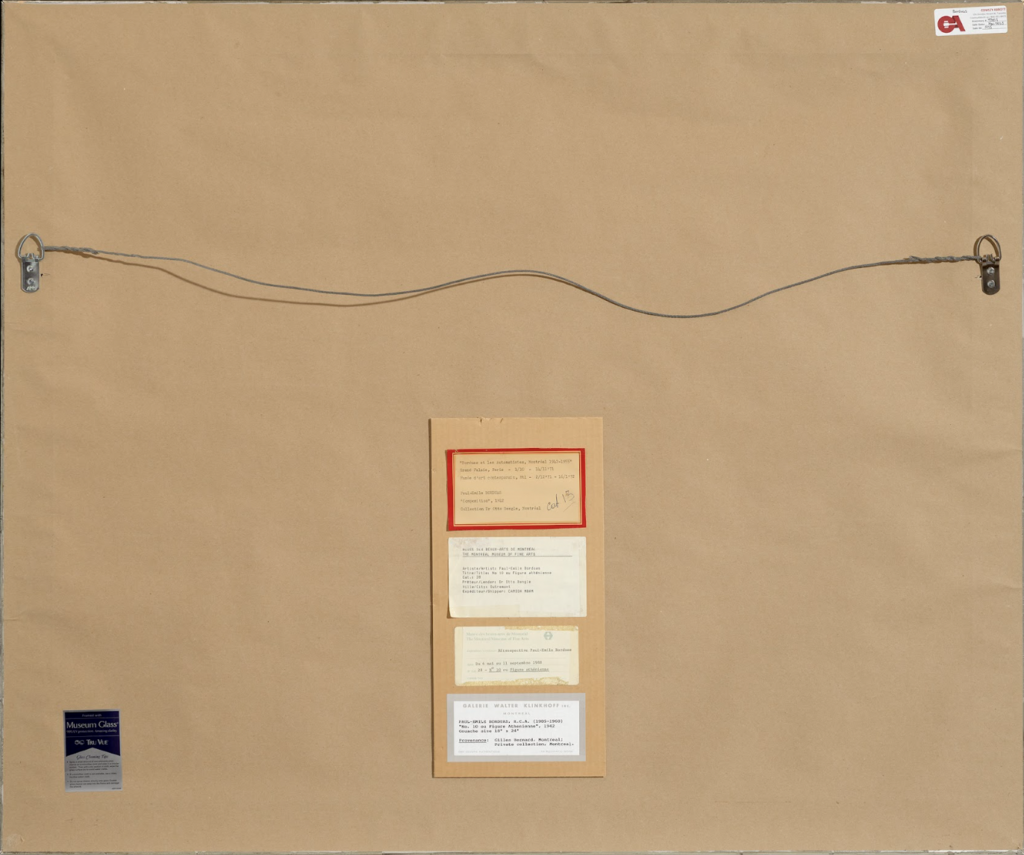
Collection of Dr. Otto Bengle, Montreal
Gilles Bernard, Montreal
Private Collection, Montreal
Galerie Walter Klinkhoff, Montreal
Masters Gallery, Calgary
Private Collection
Literature
Charles Doyon, ‘The Surrealist (sic) Borduas Exhibition’, Le Jour (2 May 1942), reproduced page 4
Robert Élie (under the pseudonym of Pierre Daniel), ‘Ravishing Paintings by Paul-Émile Borduas’ La Presse (25 April 1942), reproduced (upside down) page 55
Robert Élie, ‘Borduas’ in l’Arbre, Collection Art vivant, Montreal, 1943, unpaginated, reproduced figure 8
François-Marc Gagnon, ‘An Exhibition to See and See Again’, Le Devoir (18 December 1971), discussed page 13
Bernard Teyssèdre, Fernand Dumont and Laurier Lacroix, Borduas and the Automatists: Montreal, 1942-1955, Quebec, 1971, no. 13, discussed page 87
François-Marc Gagnon, Paul-Émile Borduas (1905-1960): Biographie critique et analyse de l’oeuvre, Montreal, 1978, reproduced page 527, figure 30
François-Marc Gagnon, “Origin of abstract art in Quebec”, Ministry of Cultural Affairs/Museum of Contemporary Art Conference, Montreal (12 October 1979), reproduced page 272
François-Marc Gagnon, ‘The meaning of the word ‘abstraction,’ in ‘art criticism and the statements of painters in the 1940s in Quebec’ in Yvan Lamonde and Esther Trépanier, The Advent of Cultural Modernity in Quebec, Quebec, 1986, reproduced page 124
Paul-Émile Borduas, “Manières de goûter une œuvre d’art” in André G. Bourassa, Jean Fisette and Gilles Lapointe, Paul-Émile Borduas: Écrits I, Montreal, 1987, pages 220, 224
François-Marc Gagnon, Paul-Émile Borduas Retrospective, Montreal, 1988, reproduced page 175, no. 28 as No. 10 or Athenian Figure
Marcel Brisebois, The Eye of the Collector, Montreal, 1996, reproduced page 47
Bernard Lamarche, ‘Borduas and the Collectors’, The 50th Anniversary of Refus Global, Le Devoir: Special Edition (9-10 May 1998), reproduced page E20
François-Marc Gagnon, Chronique du mouvement automatiste québécois 1941-1954, Montreal, 1998, pages 67-68
Robert Bernier, A Century of Painting in Quebec: Nature and Landscape, Montreal, 1999, reproduced page 150
François-Marc Gagnon, Paul-Émile Borduas. A Critical Biography, Montreal/Kingston, 2013, discussed pages 130-131
Paul-Émile Borduas: Catalogue Raisonné [online publication], Concordia University, no. 2005-0104, accessed 14 October 2025
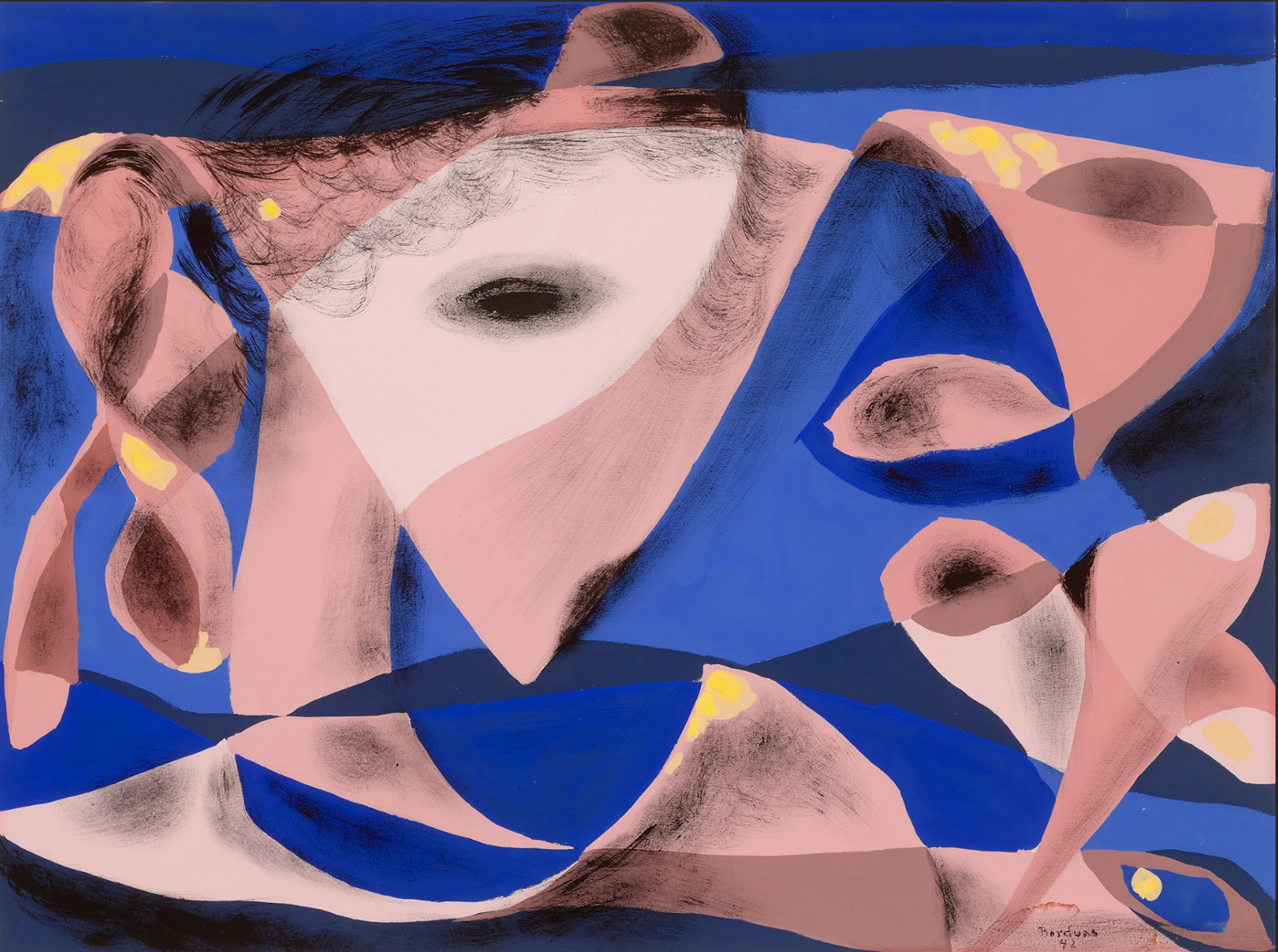
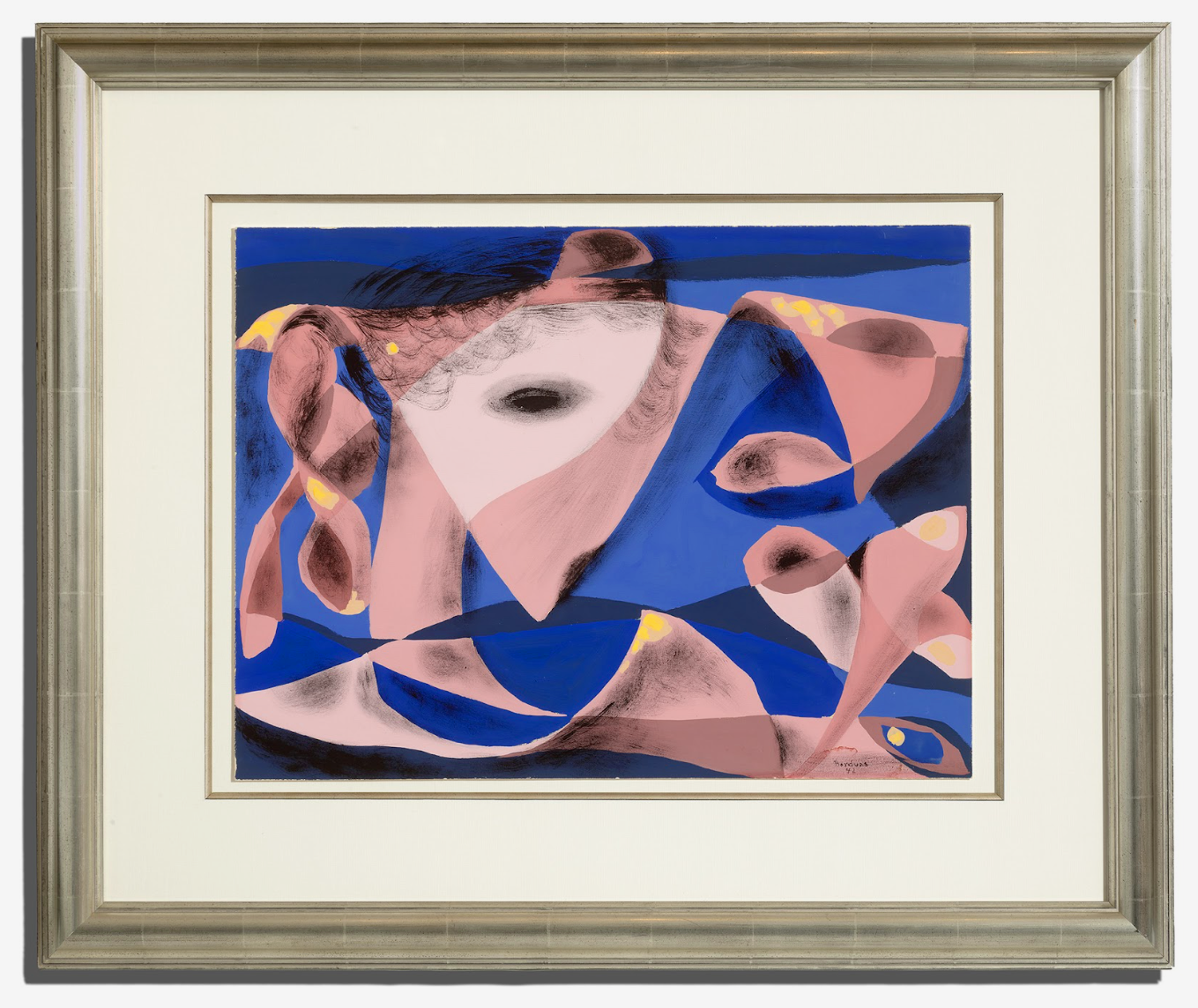
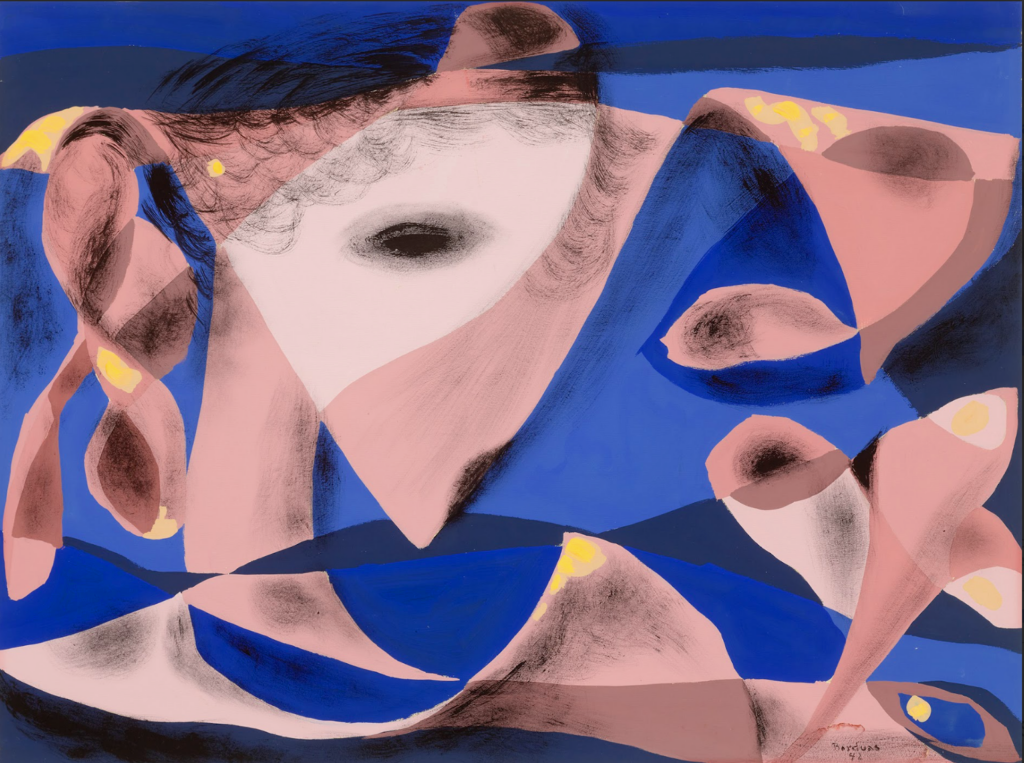
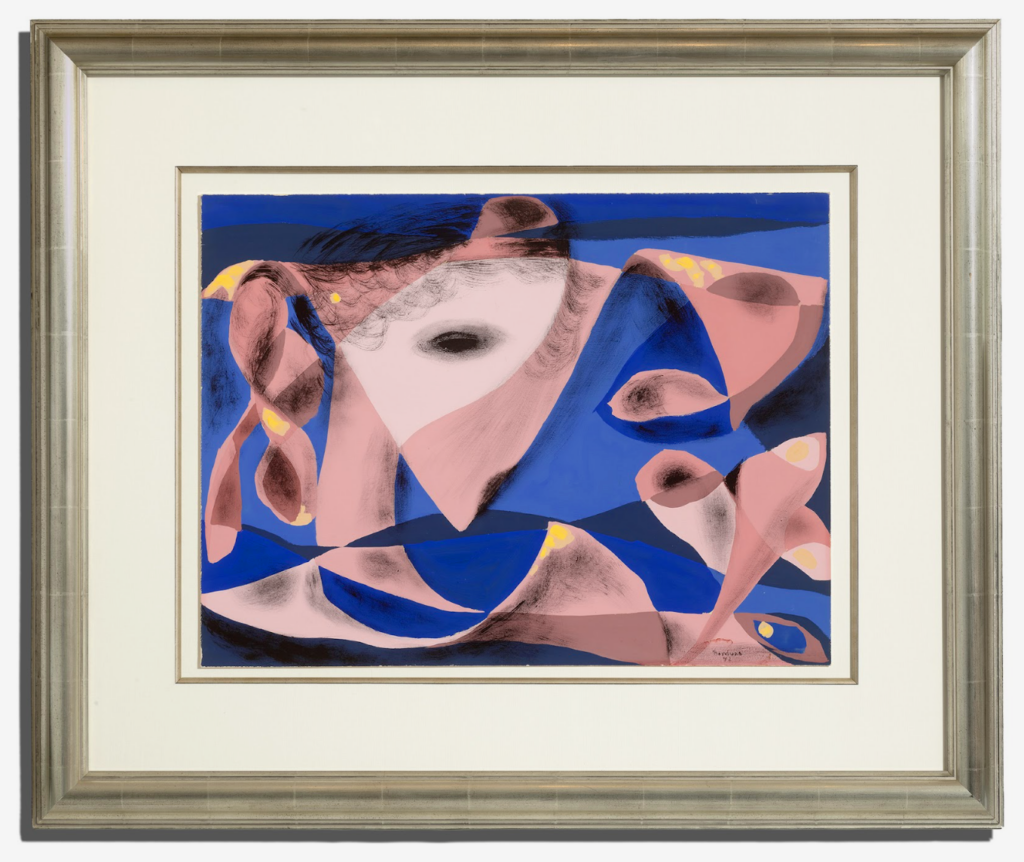
Abstraction no. 10 ou Figure athénienne belongs to the sixty or so gouaches painted by Paul-Émile Borduas during the winter of 1942, forty-five of which were exhibited from April 25 to May 2, 1942, at the Foyer de l’Ermitage in Montreal, under the title Surrealist Works of Borduas. This exhibition is particularly important because it is generally recognized as the starting point of the Montreal Automatiste movement. On this occasion, Borduas described to his friend, the art critic Maurice Gagnon, the “automatic” aspect of his approach, emphasizing the intuitive nature of the creative act: “I have no preconceived ideas. Placed in front of the blank sheet of paper with a mind free of all literary ideas, I obey the first impulse. If I have the idea of applying my charcoal to the centre of the sheet or to one of the sides, I apply it without hesitation, and so on. A first line is drawn, dividing the sheet. This division of the sheet triggers a whole thinking process that is always executed automatically.” Influenced by his recent discovery of Surrealism and his reading of André Breton’s Château étoilé, the artist no longer aimed to imitate or represent the outside world, but to adapt the means of painting to his own inner vision. The Montreal exhibition was a resounding success, with thirty-seven of the forty-five works on display being sold. It was Gilles Bernard who acquired the gouache Abstraction no. 10 ou Figure athénienne for $50.
Breaking with the usual formula of the “portrait” composition, Borduas opts for a spatial proposition which boldly embraces the landscape format. Abstraction no. 10 ou Figure athénienne echoes not only “the idealized beauty of bodies and movements” which characterizes Hellenic art but also evokes the capacity for invention of the Greeks, who “spontaneously discovered their means of plastic expression”. For Borduas, what matters now is not the subject represented, but the way in which the painter manages to translate his ideas plastically onto the canvas, to innovate by focusing on the seemingly technical questions of rhythm, volume, light and movement. The skillful combination of triangular and biomorphic forms in Abstraction no. 10 ou Figure athénienne denotes in this respect the decisive influence of Picasso, whose immense field of Cubist experimentation was of particular interest to Borduas at this time. If the latter retains from Cubism the simplification of forms, the geometrization of volumes and the representation of the subject according to various points in space, we observe in the Canadian painter more flexibility in the tracing of contours and the rendering of form. For the artist, who ventures into the terrain of non-figuration—a step that the French Surrealists would refuse to take—this is a significant leap forward. A few years before his death, positioning his work among contemporary painting practices, Borduas declared: “The gouaches of 1942, which we believed to be Surrealist, were only Cubist.”
We extend our thanks to Gilles Lapointe, associate professor in the Department of Art History at the Université du Québec à Montréal for contributing the preceding text, which has been translated from French. Lapointe is the author of several books on Paul-Émile Borduas and the Automatist movement.