



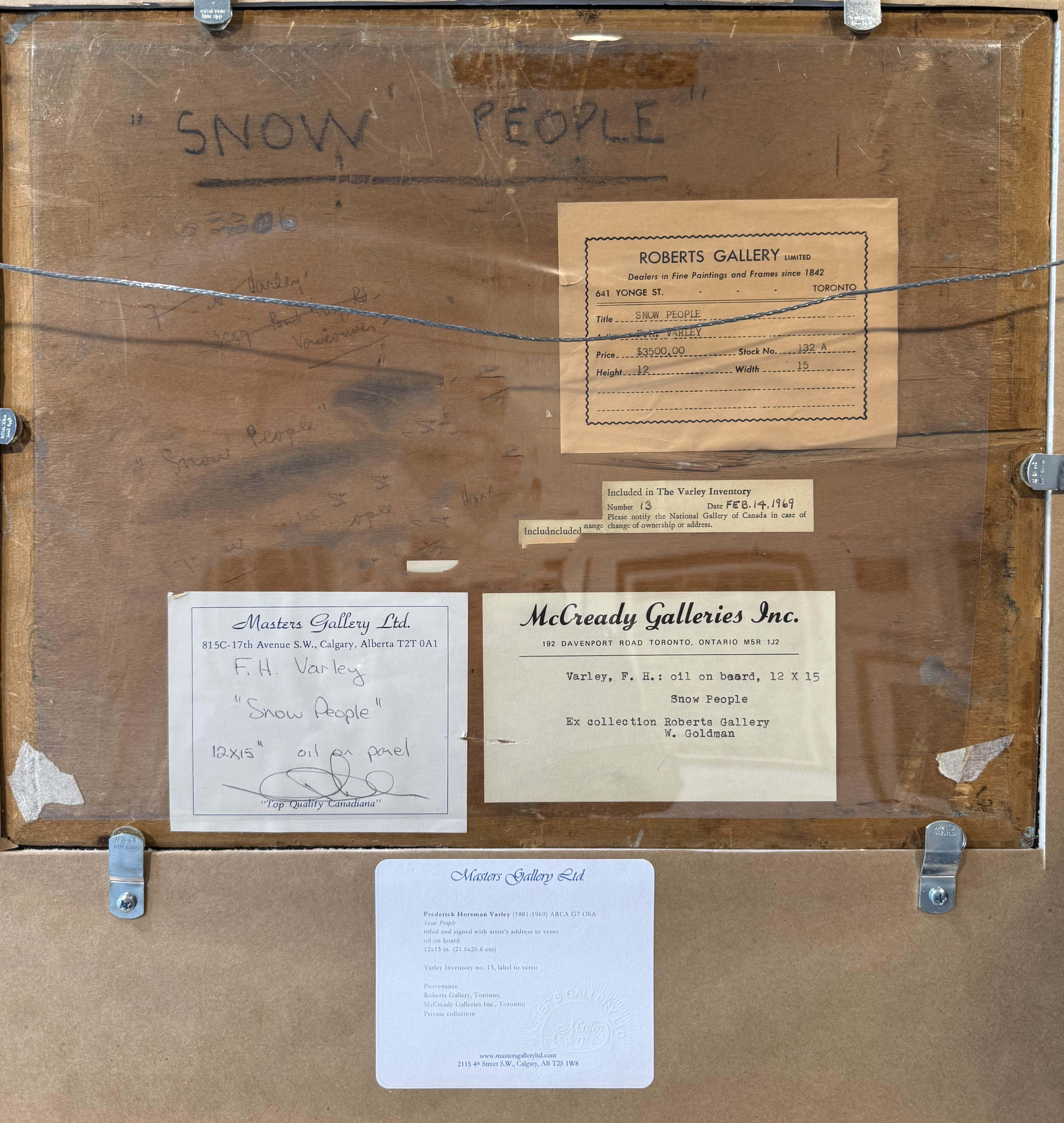


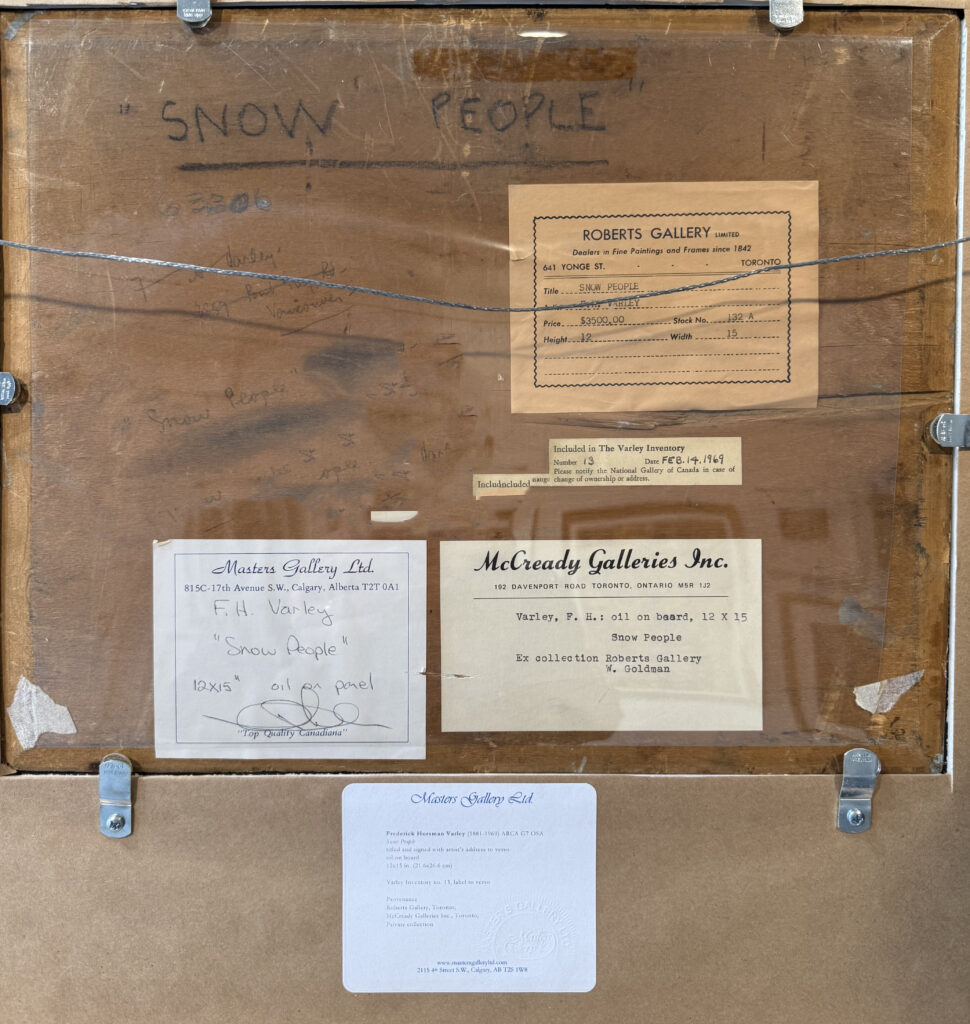
Provenance
Private collection
Roberts Gallery, Toronto
McCready Galleries, Toronto
Masters Gallery, Calgary
Private collection, Calgary
In 1926 Varley accepted an appointment to teach at the Vancouver School of Decorative and Applied Arts (now Emily Carr University of Art + Design). His move to British Columbia had a great impact on the next ten years of his life, both professionally and personally. While his reputation had rested primarily on his work as a portrait painter, during his first three years in Vancouver he confined himself almost totally to depicting his new surroundings. Varley’s British Columbia landscapes make up an important part of the gallery’s holdings; the gallery houses more than twenty-five works created during either his initial stay in the province or later visits with Kathleen McKay in the 1950s.
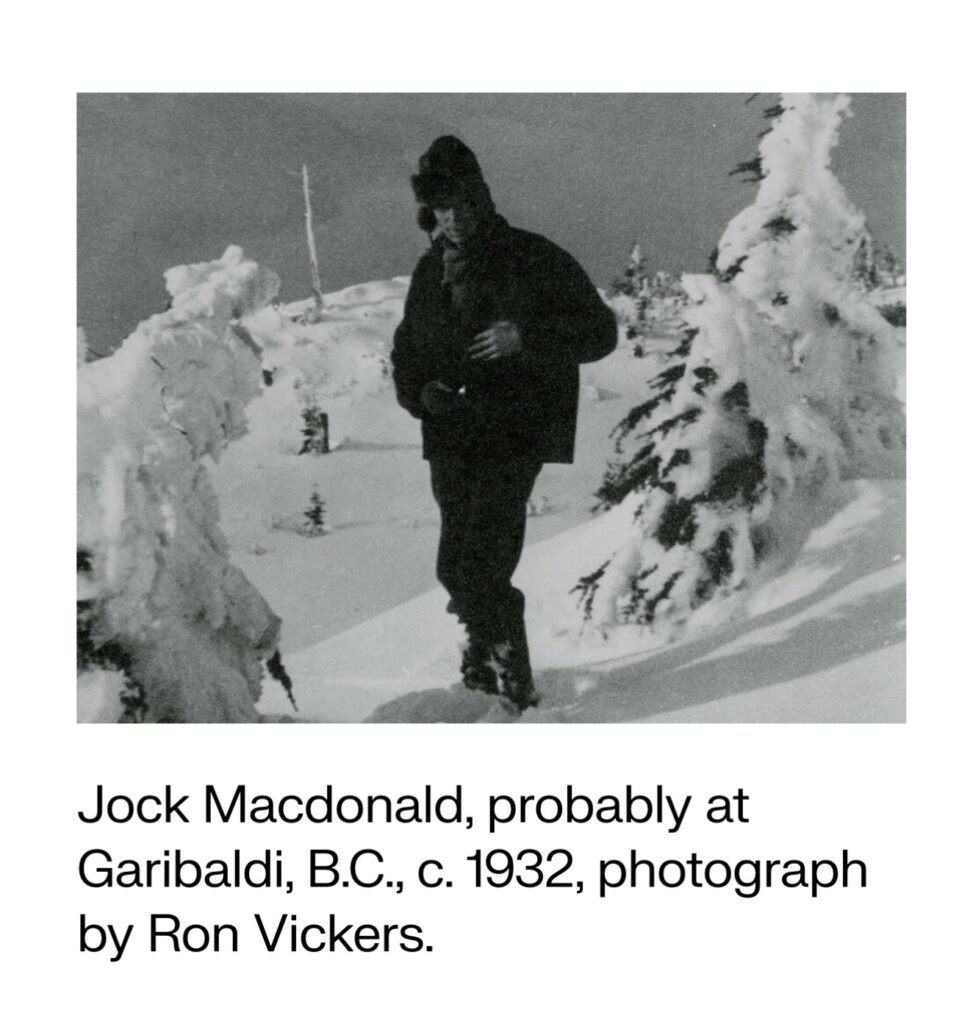
On his arrival, Varley was immediately struck by the dramatic landscape of western Canada. He explored the countryside, travelling to Garibaldi Park, Cheakamus Canyon and Lynn Valley, among other locales. He worked outdoors, hiking and camping in the mountains in search of inspiration. This new engagement with the land radically changed Varley’s approach to depicting the landscape. He began to experiment, and the rivers and mountains in his work became more abstract and fluid. He moved away from representing the landscape in its entirety, focusing instead on specific elements, such as a rocky outcrop or mist-covered line of trees.
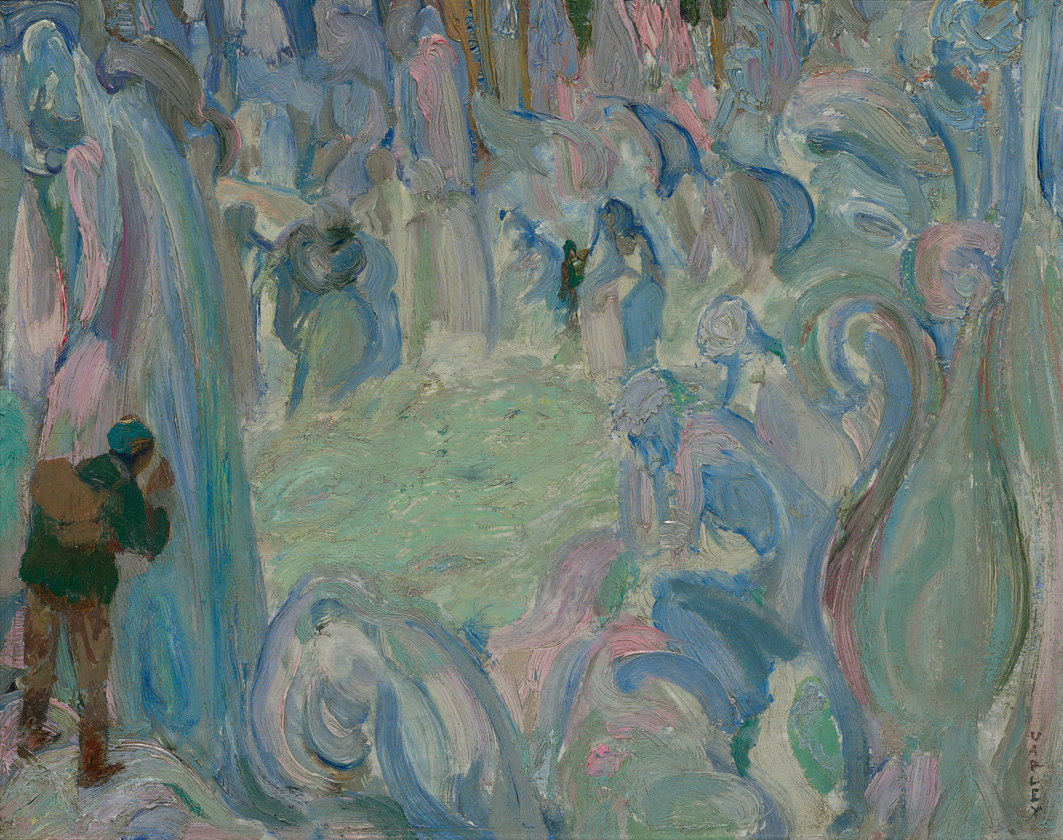
In Snow People Varley creates a fantastical and mysterious wintry scene. Shades of blue, lilac and jade are applied in an organic manner, creating soft shapes and forms like piles of snow accumulating after a flurry. The scene was very likely painted at Grouse Mountain, which Varley described in a letter as “full of fantastic forms, wind carved & polished, where one can bathe in prismatic colours, incredibly pure.”1 This oil is closely associated with two other works, a pencil sketch and watercolour (see below), both in the collection of the Varley Art Gallery of Markham, depicting the same scene. In these works, Varley imposes anthropomorphic qualities onto the landscape; the mantle of snow has been made to resemble human forms. These forms are somewhat ambiguous in the watercolour but are more pronounced in the other two pieces. In the oil painting, a figure was added in the bottom left corner, almost as a witness to this magical transformation.
Adapted from Varley Art Gallery of Markham write up for the watercolour and drawing.
F. H. Varley to Arnold Mason, 15 April 1929 (McMichael Canadian Art Collection archives). Quoted in K. Janet Tenody, “F.H. Varley: Landscapes of the Vancouver Years” (master’s thesis, Queen’s University, 1983).